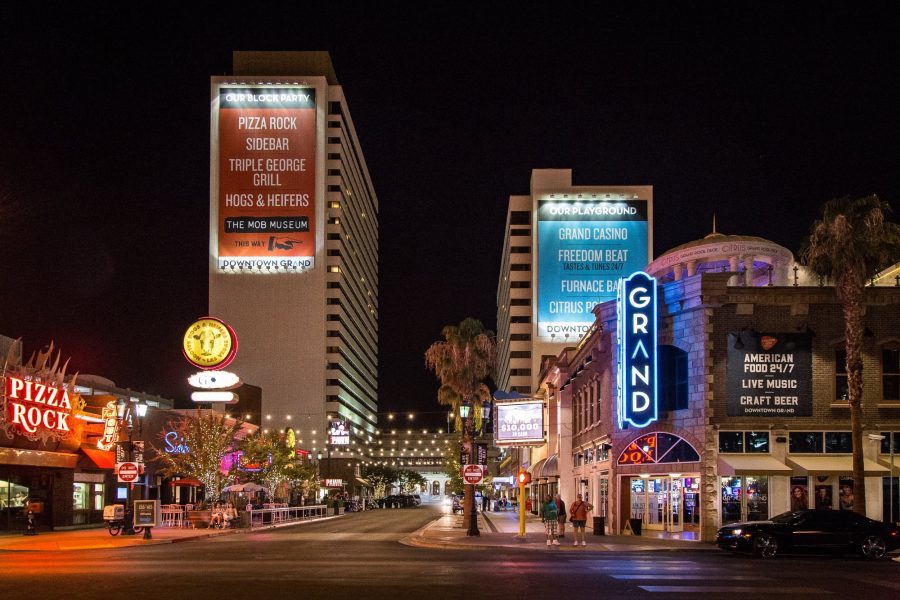
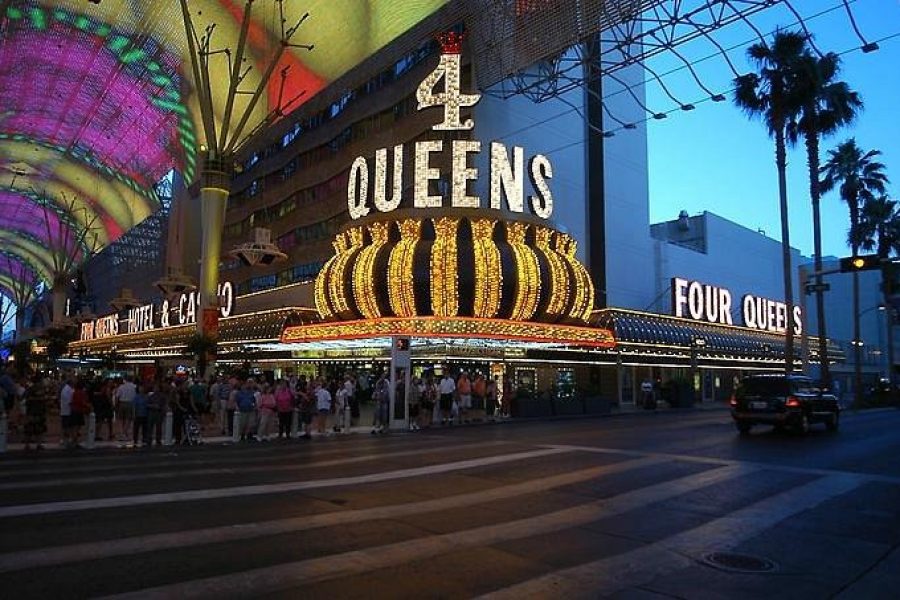
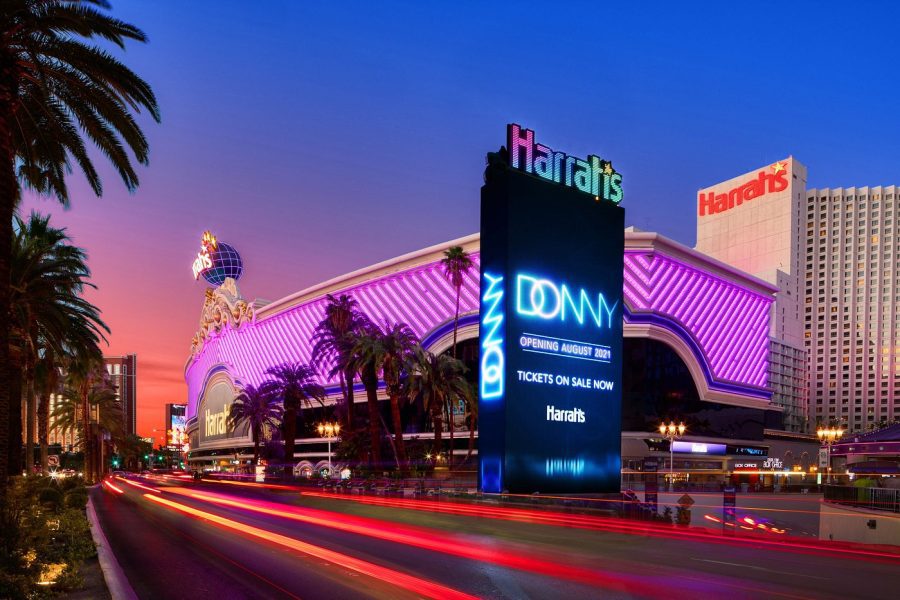
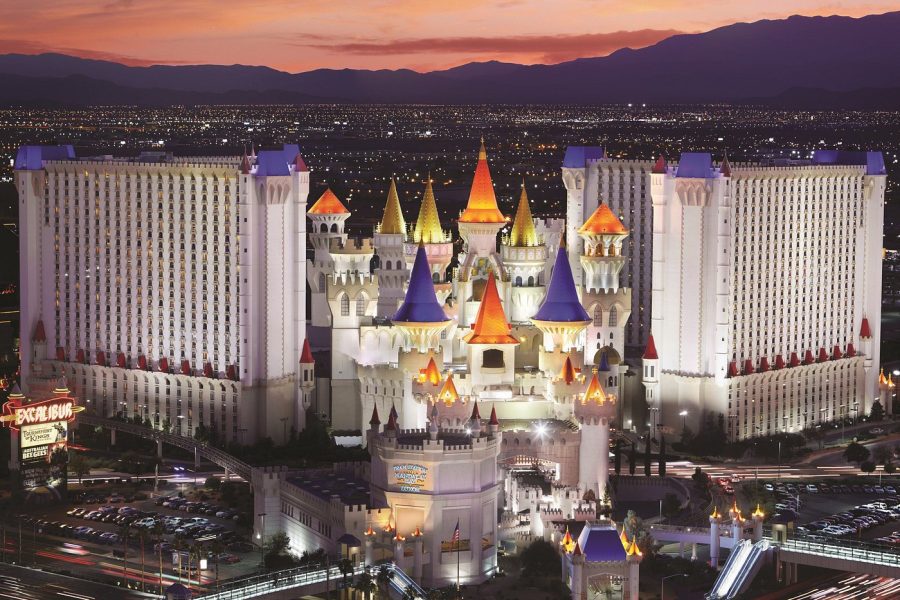
Fremont Street anchors a compact downtown grid of older casinos and tightly connected pedestrian blocks within short walking distance.
Staying in Downtown Las Vegas
Downtown Las Vegas developed differently from most large American city centers because tourism, casinos, and entertainment replaced the traditional corporate downtown structure decades ago. Fremont Street still acts as the visual and pedestrian center of the area, but much of downtown spreads through older casino blocks, parking structures, event venues, and low-rise commercial streets that feel disconnected from the glass-resort environment of the Strip. The district becomes noticeably more active after sunset, when pedestrian traffic, concerts, sports events, and casino activity begin to dominate the area. For visitors staying downtown, hotels are usually positioned within a smaller and more walkable grid than the Strip, with quicker access to older casinos, music venues, and the original urban core of Las Vegas.
Why Downtown Las Vegas Feels More Compact Than the Strip
The physical structure of downtown Las Vegas is very different from the Strip, even though tourists often treat both areas as part of the same destination. Most of the downtown district developed before the era of giant resort complexes, which is why the street grid remains tighter, the blocks shorter, and the casino entrances positioned directly along the sidewalk. On the Strip, many hotels sit deep behind multilane roads, pedestrian bridges, fountains, parking garages, and private resort infrastructure that increases walking distances far beyond what appears on a map.
Downtown Las Vegas functions more like a concentrated entertainment district compressed into several connected blocks around Fremont Street. Older casinos were built closer to one another, often without the massive setbacks and internal shopping corridors that define newer Strip resorts. Because of this, movement through downtown feels more continuous. Visitors pass directly between casinos, bars, sports books, concert spaces, and older hotel towers without repeatedly entering large enclosed resort complexes.
This difference becomes especially noticeable late at night, when pedestrian traffic remains concentrated within a relatively small area instead of dispersing across several miles of boulevard. The result is not necessarily a quieter or simpler version of Las Vegas, but a more compressed one.
Inside Downtown Las Vegas Hotels
How Far Everything Actually Is in Downtown Las Vegas
Downtown Las Vegas is structured around a short stretch of Fremont Street, but the sense of distance changes quickly once you move off the main pedestrian zone. The central corridor itself is only a few blocks long, and movement through it is continuous, with casinos and entrances positioned directly along the walkway.
Beyond that strip, the grid breaks into smaller segments. Fremont East is one of them, where bars, low-rise venues, and older storefronts sit closer together, but without the same uninterrupted pedestrian flow. A few blocks away, the density drops again, replaced by parking lots, service roads, and larger gaps between buildings that interrupt how the area reads spatially.
Distances are short in absolute terms, but the structure is uneven. What feels like a single connected district on a map is, on the ground, a sequence of compact zones separated by transitional spaces. Walking between them is rarely linear; it moves through shifts in scale rather than one continuous urban surface.
Downtown Hotels in Las Vegas – Frequently Asked Questions
Downtown Las Vegas is generally anchored around Fremont Street and the surrounding blocks. The dense hotel and casino area fades out within a few short grids north and south, where the street pattern shifts from entertainment-focused blocks to more open, mixed-use and service-oriented streets.
Fremont Street runs through the center of the district and functions as the most continuous pedestrian surface. Most hotel and casino activity is concentrated within a few intersecting blocks around this corridor, with density decreasing quickly beyond it.
Because the area was not developed as a single planned resort zone. Some blocks are tightly packed with casinos and entertainment venues, while adjacent blocks contain parking structures, service roads, or lower-rise buildings that interrupt visual continuity.
Fremont East extends the downtown grid beyond the main pedestrian corridor. It contains smaller venues and bars, but with lower pedestrian density and more spaced-out building structure compared to the central Fremont Street zone.
The Strip is organized as a continuous resort corridor with large properties occupying entire city blocks or more. Downtown Las Vegas is built on a tighter street grid where individual buildings occupy smaller footprints and directly face the street, creating a more fragmented layout.
Distances between hotels are short in absolute terms, often just one or two blocks. The perception of distance changes depending on whether movement stays within Fremont Street or crosses into surrounding blocks where the street rhythm becomes less continuous.
Most downtown hotels open directly onto street-level sidewalks, without the layered internal walkways and enclosed resort corridors common on the Strip. Movement between properties happens externally, at ground level.
Because they show a continuous grid, while the actual experience is segmented. Active zones are concentrated in clusters, and transitions between them include spaces that are not primarily pedestrian or entertainment-focused.
Where the Grid Stops Feeling Like a Tourist Area
Downtown Las Vegas stays concentrated around Fremont Street, where casinos and pedestrian movement occupy a tight cluster of blocks. One or two streets away, the pattern changes. Parking structures appear between buildings, some corners open into empty intersections, and foot traffic stops being continuous.
North and east of the core, the blocks no longer behave the same way. A few carry activity from bars and smaller venues, while others act more like connectors between active points rather than destinations themselves. The difference is not marked by signage or boundaries, only by how often people actually move through them.
Explore Downtown Hotels in Other Popular U.S. Cities